|
| [1] |
Sharon Powers.
"He suddenly lost concern for himself, and forgot to look at a menacing fate. He became not a man but a member. He felt that something of which he was a part--a regiment, an army, a cause, or a country--was in a crisis. He was welded into a common personality which was dominated by a single desire. For some moments he could not flee, no more than a little finger can commit a revolution from a hand." (The Red Badge of Courage, Chp. 5, p. 34.)
Henry Fleming, protagonist in The Red Badge of Courage, has a flash of realization that he isn't really an individual, but only a part of a group; and, in that moment, his self preservation--which previously blinded him to a larger struggle--fled. We've heard of the heroics of persons who, forgetting themselves, have run into a burning building to save someone, or jumped under a subway train to save a child. These examples, are undoubtedly, the most noble actions of selflessness. But, as we will see below, selflessness can also be hazardous. [2]
BOOK SYNOPSIS:
The book opens about six months after the Hunger Games have concluded and Peeta and Katniss were declared winners. The Victory Tour is about to begin and President Snow visits Katniss to deliver an ultimatum: convince all of Panem and Snow that she and Peeta acted out of love and not "rebellion." If she doesn't, dire consequences to her and her family will follow.
On the very first Victory Tour stop, District 11, the District that Rue came from, Katniss impulsively speaks about Rue--the District's listeners honor Katniss and salute her. Katniss and Peeta are rushed out, but not before they see a man shot in the head and killed by the Peacekeepers.
The Victory Tour ends with a stop at the Capitol and a special appearance. Peeta proposes to Katniss in front of the crowd in a last-ditch attempt to show that their actions in the arena were out of love, not insurrection. President Snow lets Katniss know it was not enough to convince him or the public; Katniss now knows that she and her family are in danger.
Before she goes home, she has a strange meeting with the new Head Games Keeper, Plutarch Heavens- bee. Plutarch shows her his watch--it has a Mockingjay on it--he points to the watch and says, "It starts at midnight." Katniss doesn't understand his strange and cryptic behavior and comment, and returns home full of fear for her family.
The 75th Hunger Games, The Quarter Quell announcement, shocks everyone: the competitors for the games will be harvested from all the previous winners. Peeta and Katniss are selected and soon head back to the Capitol for training. Katniss decides that she will do whatever it takes to save Peeta, even though it is highly likely to result in her death. Unbeknownst to Katniss, Peeta promises to himself to save Katniss.
When training begins, Haymitch urges the two to try for an alliance with some of the other competitors. Reluctantly, Katniss settles on Finnick and Mags, Beetee and Wiress, and Johanna. Then came the pre-game interviews. Peeta drops a bomb when he tells everyone that Katniss and he were secretly married and that she is expecting a baby.
As Cinna is seeing Katniss off to the beginning of the games, she watches in horror as he is grabbed and beaten and then dragged off. Katniss rises into the arena and the games are on. A series of adventures plagues the team and they begin losing people. Sadly, Mags dies and the others are injured--all the while Katniss doesn't know if she can trust anyone.
Beetee, trying to blow the dome force-field, is injured, so Katniss shoots an arrow into the force field to cause it to short out. It does and she and some of the others are rescued by a hovercraft that has Haymitch, Plutarch Heavensbee, and her friend Gale on board. Gale tells Katniss that their home, District 12, was destroyed by the government and that the government had captured Johanna and Peeta. They are taken to District 13 to safety and for medical treatment. [6]
MY FAVORITE QUOTE:
I selected this quote for my daughter, Sherri, who asked me what I thought about the mother-daughter relationship between Katniss and her mother. Since I didn't address this relationship in the first book, let's take a look at it, here, in Catching Fire.
We find this happens in today's so-called "modern" society, too. No matter what the problem, whether its depress- ion, drugs or alcohol, when a child is parentified, it causes detriment to the relationship. Katniss, in choosing to take Prim's place at the 24th Hunger Games, was propelled into a situation she was ill-prepared to face.
In that realization, Katniss understands that her mother was also ill-equipped to face caring for two small children alone after her husband's death. It was in the Hunger Games, as horrible as they were, that Katniss grew to understand her mother better and let love back in. Katniss was able to let go of her anger over the unfairness of it all and begin to let the relationship heal. Undoubtedly, we will see the relationship continue on in the third book of the series, Mockingjay.
THE MOVIE--Catching Fire:
The movie, Catching Fire, was released to the big-screen just a year ago on November 22, 2013. The movie was nominated and won many accolades in the year since it has been released. So, to see what the hub-bub was all about, let's take a quick look at a trailer of the movie [10]:
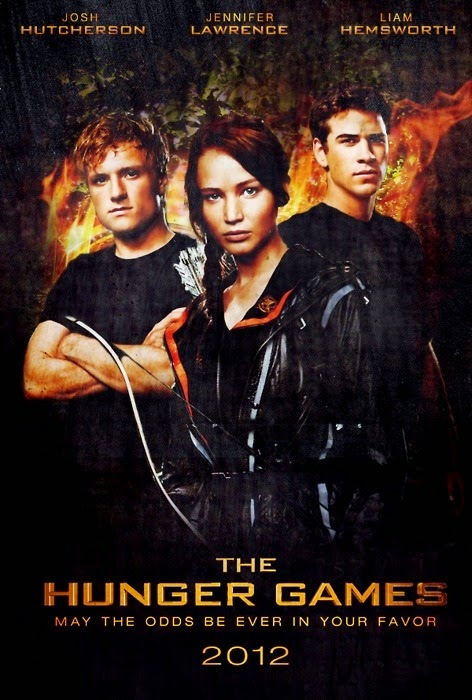
Directing the movie was Francis Lawrence with screenwriting credits going to Suzanne Collins (novel) and Simon Beaufoy and Michael Arndt (for screenplay). Starring in the film is Jennifer Lawrence as Katniss Everdeen, Josh Hutcherson as Peeta Mellark, Liam Hemsworth as Gale Hawthorne, Woody Harrelson as Haymitch Abernathy, Donald Sutherland as President Snow, Stanley Tucci as Cesar Flickerman, Philip Seymour Hoffman as Plutarch Heavensbee, Elizabeth Banks as Effie Trinket, Lenny Kravitz as Cinna, and many others.
WHAT I THINK ABOUT THE BOOK:
WHAT WORKS FOR ME:
In high school, I came to a crossroads when I had to decide whether or not to follow the crowd, or go on a path of my own. It was definitely harder for me, but I chose not to follow the crowd. It meant I had fewer friends and fewer opportunities to go to parties and other outings, but I am happy with the choice I made back then. I didn't ever have to worry over whether or not I would be judged and found wanting by the crowd--I thought and acted for myself.
This concept, about "thinking for yourself" is paramount in getting through life, and it is paramount in the book, as well. One of the reasons I used Stephen Crane's, The Red Badge of Courage, to open the blog post today was for that very reason. Crane shows us how cogs in machines just go along with the other cogs, working in the same way, never deviating from what they do. They do not think. That simply means they do not have to consider whether or not what they are doing is right or wrong. The unthinking cogs do not exhibit discretion or judgment in any given situation.
In Catching Fire, the government, and by extension, the games makers, and Capitol people who support the government are nothing more than a machine and it's people--cogs. Unthinking. Incapable of using discretion or good judgment concerning people other than themselves. They do not even consider whether or not what they are doing with the children of the districts is right or wrong.
The government, the games and the people are incapable of understanding that their watching the Hunger Games on television, cheering, betting, and celebrating when one child killed another child, and they won their bet is wrong. Likewise they fail to see that their government's division of citizens into districts and then prohibiting their free travel is wrong--which by the way, sounds a lot like the concentration and work camps and internment camps of WWII. [13]
When a government claims that the needs of society outweigh the needs of the individual, freedom of choice is diminished or lost. Even today, this concept is still around, and hasn't disappeared from society. Suzanne Collins masterfully sets the stage for the trilogy by utilizing this concept.
Another wonderful concept Suzanne Collins has incorporated into the story is that of selflessness. For example, both Peeta and Katniss, want to set aside their own well-being to protect each other. They each make bargains with Haymitch to do so.
And then there is Cinna. Oh, wonderful Cinna. We later learn Cinna is involved with the underground, the insurrectionists. He selflessly chooses to put his life on the line to both promote Katniss and help her, and also to help "kindle" a fire under the movement. Cinna created the wedding dress to end all wedding dresses--one that transformed into the exotic, wild, breath-taking and world shaking black mockingjay. In effect, he showed the world that Katniss was THE mockingjay. Undoubtedly, he knew his time was up--selfless to the end. One last example: half of the competitors were in on the agreement to help save Katniss and Peeta, and a number of them, in fact, sacrificed themselves to help Katniss and Peeta survive.
WHAT DIDN'T WORK FOR ME:
Now I know that Katniss is a young teenager. However, she was forced to grow up early when her father died and she had to take over the care of the family. And...Katniss has always been portrayed as intelligent and creative and quick to learn. So why does Collins from time to time treat her as if she is stupid?
After she met the two women in the woods by the lake, she knew that she was everyone's "mockingjay." She knew the symbol of the insurrection was the "mockingjay." So, why, when Heavensbee shows her a personal item--a pocket watch--with a mockingjay put on it does she not recognize him as being with the insurrection? He even gives her a clue as to what is coming and she doesn't get it.
Beetee and Wiress speak with Katniss in the training center discussing the forcefield shield and how it can be seen in the little patch-like areas. And why, for heavens sake would Beetee and Wiress give away an obvious advantage to an opponent? I mean, Katniss recognizes it as an advantage, because she didn't even want to divulge how she knew about the forcefield to people in her alliance--she comes up with the lame excuse that she can hear it. Really? She doesn't recognize people are helping her?
And what about Finnick? She sees the bracelet that Haymitch wore on Finnick and she still doesn't trust him. What does she think? Finnick mugged Haymitch to get the bracelet? And there's Mags, too. She trusts Finnick with her life and still Katniss doesn't trust Finnick. Oh, and let's not forget he uses CPR on Peeta to bring him back from near death. During the deadly fog incident Finnick carries him on his back when he could have just left him and saved himself--he lets Mags walk into the deadly fog and doesn't stop her, but he keeps helping Peeta. Still, Katniss doesn't trust him.
Finally, I think Snow is a fool. He obviously has so many "yes" men around him that when someone (Heavensbee) with any intelligence comes in, he (Heavensbee) gives him a "Snow" job. Really, President Snow, have you never heard that there is no such thing as "bad" publicity, only publicity. So why give Katniss all that publicity when you could have sent her back to obscurity and anonymity to be lost forever in history. So what would I say to Snow? I'd say, "Snow, you're the one who lit the match that started the revolution.
THE HUNGER GAMES: CATCHING FIRE
THE OFFICIAL ILLUSTRATED MOVIE COMPANION:
The companion book is organized into six parts:
(1) The Hunger Games Catches Fire;
(2) Moving Forward;
(3) Expanding the World of Panem;
(4) Designing the Arena;
(5) Creating Costumes, Designing Faces; and,
(6) Looking Ahead.
Part one reaches back to book 1, The Hunger Games, to speak about the phenomenon of the book and movie. Then the chapter moves on to the continued story of Catching Fire. Here the author explains that Katniss is now a veteran, but still wants to protect those she loves and is "awake," now; even so, Katniss is still not ready to lead.
 Part two showcases how the director was so important to the filming of the story, and then went on to tell how the casting was accomplished by considering actors from all over the world. Also, the importance of some of the character's roles was stressed, for example, Plutarch Heavensbee, the mentor, Haymitch, and Finnick and Mags.
Part three, tells the story of how the filmmakers put the world of Panem together, how it was imagined, the logistics of filming, and how continuity was incorporated without losing the individuality of the various districts. Also in this chapter, the Presidential Feast is highlighted along with the setting, The Swan House in Atlanta.
 Part four, Designing the Arena, of course, reveals how the company first searched out an appropriate location, but how they worked with the limitations set upon them. The cornucopia and its creation is explained, along with a number of photographs, and then how it was set into the arena as the center of the dial of a clock. Covering the aspect that a true tropical forest setting was needed, the filming in Hawaii and the challenges of the arena filming were, likewise, covered. We also get to see "Life on the Set," and how the actors got to intermingle.
Part five covered, in detail, the creation of the costumes and how certain looks were created for Katniss, Gale Hawthorne, for Katniss's wedding dress, Peeta Mellark's changing look, Cinna, Finnick, Effie Trinket, the Avoxes, Haymitch Abernathy, President Snow, Plutarch Heavensbee, and the uniforms for the games. The challenges of creating a look for each actor were discussed, as well as the problems with functionality of the uniforms.
In Part six, the last chapter, discusses how in the first book we were introduced to Katniss and got to know her and who she is. Then, in Catching Fire, the metaphor that Katniss is a "burning ember" that starts the fire of revolution. And lastly, how in Mockingjay, how the Capitol will feel the "wrath" of the districts. (p.154.)
CONCLUSION OF MOVIE GUIDE:
Like the companion guide to The Hunger Games that I reviewed in my last post, I thoroughly enjoyed this book. Here, we get to see a bit more of what happens behind the scenes, what goes on on the set, and how the actors relate to each other. In addition I liked learning more about the motivations of some of the characters and how book two is really fleshing out the story of Katniss. I really liked that the focus was on Katniss's growth of her character. I give this guide 4.0 stars out of 5.
______________________________________________________
MY RECOMMENDATIONS AND RATING FOR CATCHING FIRE:
As I mentioned in my blog post of Hunger Games, it is difficult to avoid the fact that the movie has violence, death, and fighting at every turn. The movie, mentioned above, is rated by MPAA as PG-13 for "intense sequences of violence and action, some frightening images, thematic elements, a suggestive situation and language. [20]
I would, therefore, advise that young children should be guided by their parents, and sensitive persons consider the material before watching. Those of the appropriate age will, undoubtedly, enjoy the book and movie.
RATING: Even with what I consider minor criticisms I have given, I really loved the book. Therefore, I am happy to rate this book 4.5 stars out of 5. I had reread this book in anticipation of my reviewing it for my blog post, today. I am not disappointed in my rereading of it, nor have I changed my opinion of the good quality of the novel. I highly recommend this book to everyone who loved The Hunger Games.
Thank you for joining me this week as we got to look at the exciting novel by Suzanne Collins, Catching Fire. I thank you for taking time to read my blog post and consideration of the information I have presented. Do something good for yourself: please take some time to read a little this week. And...please join me again, next week as we review the last book of the trilogy of The Hunger Games, The Mockingjay. I can hardly wait!
Until next time...
...many happy pages of reading!
My love to you all!
Sharon.
 |
| [3] |
On the very first Victory Tour stop, District 11, the District that Rue came from, Katniss impulsively speaks about Rue--the District's listeners honor Katniss and salute her. Katniss and Peeta are rushed out, but not before they see a man shot in the head and killed by the Peacekeepers.
 |
| [4] |
Before she goes home, she has a strange meeting with the new Head Games Keeper, Plutarch Heavens- bee. Plutarch shows her his watch--it has a Mockingjay on it--he points to the watch and says, "It starts at midnight." Katniss doesn't understand his strange and cryptic behavior and comment, and returns home full of fear for her family.
The 75th Hunger Games, The Quarter Quell announcement, shocks everyone: the competitors for the games will be harvested from all the previous winners. Peeta and Katniss are selected and soon head back to the Capitol for training. Katniss decides that she will do whatever it takes to save Peeta, even though it is highly likely to result in her death. Unbeknownst to Katniss, Peeta promises to himself to save Katniss.
 |
| [5] |
 |
| Beetee. [7] |
Beetee, trying to blow the dome force-field, is injured, so Katniss shoots an arrow into the force field to cause it to short out. It does and she and some of the others are rescued by a hovercraft that has Haymitch, Plutarch Heavensbee, and her friend Gale on board. Gale tells Katniss that their home, District 12, was destroyed by the government and that the government had captured Johanna and Peeta. They are taken to District 13 to safety and for medical treatment. [6]
 |
| by Albert Anker [8] |
I selected this quote for my daughter, Sherri, who asked me what I thought about the mother-daughter relationship between Katniss and her mother. Since I didn't address this relationship in the first book, let's take a look at it, here, in Catching Fire.
My mother laughs, and I think about how there was no going back after I took over caring for the family when I was eleven. How I will always have to protect her...Since I've been home I've been trying hard to mend my relationship with my mother. Asking her to do things for me instead of brushing aside any offer of help, as I did for years out of anger...My time in the arena made me realize how I needed to stop punishing her for something she couldn't help, specifically the crushing depression she fell into after my father's death. Because sometimes things happen to people and they're not equipped to deal with them. (p. 31)It is so very difficult for children to be forced into a parental role through no fault of their own. Katniss ended up taking over her mother's role when Katniss's father died. Katniss went hunting for food, learned how to trade her game for food, how to set snares, and how to become proficient with a bow and arrow. Katniss was forced to learn how to care for her mother and little sister Prim, something no eleven-year-old should have to do.
 |
| [9] |
In that realization, Katniss understands that her mother was also ill-equipped to face caring for two small children alone after her husband's death. It was in the Hunger Games, as horrible as they were, that Katniss grew to understand her mother better and let love back in. Katniss was able to let go of her anger over the unfairness of it all and begin to let the relationship heal. Undoubtedly, we will see the relationship continue on in the third book of the series, Mockingjay.
THE MOVIE--Catching Fire:
The movie, Catching Fire, was released to the big-screen just a year ago on November 22, 2013. The movie was nominated and won many accolades in the year since it has been released. So, to see what the hub-bub was all about, let's take a quick look at a trailer of the movie [10]:
Directing the movie was Francis Lawrence with screenwriting credits going to Suzanne Collins (novel) and Simon Beaufoy and Michael Arndt (for screenplay). Starring in the film is Jennifer Lawrence as Katniss Everdeen, Josh Hutcherson as Peeta Mellark, Liam Hemsworth as Gale Hawthorne, Woody Harrelson as Haymitch Abernathy, Donald Sutherland as President Snow, Stanley Tucci as Cesar Flickerman, Philip Seymour Hoffman as Plutarch Heavensbee, Elizabeth Banks as Effie Trinket, Lenny Kravitz as Cinna, and many others.
WHAT I THINK ABOUT THE BOOK:
WHAT WORKS FOR ME:
 |
| Human beings have choices to make-- go with the crowd, or go your own way? [11] |
This concept, about "thinking for yourself" is paramount in getting through life, and it is paramount in the book, as well. One of the reasons I used Stephen Crane's, The Red Badge of Courage, to open the blog post today was for that very reason. Crane shows us how cogs in machines just go along with the other cogs, working in the same way, never deviating from what they do. They do not think. That simply means they do not have to consider whether or not what they are doing is right or wrong. The unthinking cogs do not exhibit discretion or judgment in any given situation.
 |
| [12] |
The government, the games and the people are incapable of understanding that their watching the Hunger Games on television, cheering, betting, and celebrating when one child killed another child, and they won their bet is wrong. Likewise they fail to see that their government's division of citizens into districts and then prohibiting their free travel is wrong--which by the way, sounds a lot like the concentration and work camps and internment camps of WWII. [13]
 |
| Do you remember this Star Trek quote: "The needs of the many outweigh the needs of the few, or the one"? [14] |
Another wonderful concept Suzanne Collins has incorporated into the story is that of selflessness. For example, both Peeta and Katniss, want to set aside their own well-being to protect each other. They each make bargains with Haymitch to do so.
 |
| Cinna. Did you cry over the death of this fictional character? [15] |
WHAT DIDN'T WORK FOR ME:
 |
| [16] |
After she met the two women in the woods by the lake, she knew that she was everyone's "mockingjay." She knew the symbol of the insurrection was the "mockingjay." So, why, when Heavensbee shows her a personal item--a pocket watch--with a mockingjay put on it does she not recognize him as being with the insurrection? He even gives her a clue as to what is coming and she doesn't get it.
 |
| [17 |
And what about Finnick? She sees the bracelet that Haymitch wore on Finnick and she still doesn't trust him. What does she think? Finnick mugged Haymitch to get the bracelet? And there's Mags, too. She trusts Finnick with her life and still Katniss doesn't trust Finnick. Oh, and let's not forget he uses CPR on Peeta to bring him back from near death. During the deadly fog incident Finnick carries him on his back when he could have just left him and saved himself--he lets Mags walk into the deadly fog and doesn't stop her, but he keeps helping Peeta. Still, Katniss doesn't trust him.
Finally, I think Snow is a fool. He obviously has so many "yes" men around him that when someone (Heavensbee) with any intelligence comes in, he (Heavensbee) gives him a "Snow" job. Really, President Snow, have you never heard that there is no such thing as "bad" publicity, only publicity. So why give Katniss all that publicity when you could have sent her back to obscurity and anonymity to be lost forever in history. So what would I say to Snow? I'd say, "Snow, you're the one who lit the match that started the revolution.
 |
| [18] |
THE OFFICIAL ILLUSTRATED MOVIE COMPANION:
The companion book is organized into six parts:
(1) The Hunger Games Catches Fire;
(2) Moving Forward;
(3) Expanding the World of Panem;
(4) Designing the Arena;
(5) Creating Costumes, Designing Faces; and,
(6) Looking Ahead.
Part one reaches back to book 1, The Hunger Games, to speak about the phenomenon of the book and movie. Then the chapter moves on to the continued story of Catching Fire. Here the author explains that Katniss is now a veteran, but still wants to protect those she loves and is "awake," now; even so, Katniss is still not ready to lead.
Part two showcases how the director was so important to the filming of the story, and then went on to tell how the casting was accomplished by considering actors from all over the world. Also, the importance of some of the character's roles was stressed, for example, Plutarch Heavensbee, the mentor, Haymitch, and Finnick and Mags.Part three, tells the story of how the filmmakers put the world of Panem together, how it was imagined, the logistics of filming, and how continuity was incorporated without losing the individuality of the various districts. Also in this chapter, the Presidential Feast is highlighted along with the setting, The Swan House in Atlanta.
Part four, Designing the Arena, of course, reveals how the company first searched out an appropriate location, but how they worked with the limitations set upon them. The cornucopia and its creation is explained, along with a number of photographs, and then how it was set into the arena as the center of the dial of a clock. Covering the aspect that a true tropical forest setting was needed, the filming in Hawaii and the challenges of the arena filming were, likewise, covered. We also get to see "Life on the Set," and how the actors got to intermingle. |
| The above three photographs are of my copy of The Hunger Games: Catching Fire: The Official Illustrated Movie Companion. |
In Part six, the last chapter, discusses how in the first book we were introduced to Katniss and got to know her and who she is. Then, in Catching Fire, the metaphor that Katniss is a "burning ember" that starts the fire of revolution. And lastly, how in Mockingjay, how the Capitol will feel the "wrath" of the districts. (p.154.)
CONCLUSION OF MOVIE GUIDE:
 |
| [19] |
______________________________________________________
MY RECOMMENDATIONS AND RATING FOR CATCHING FIRE:
 |
| Katniss Everdeen exhibits some of these signs and symptoms of PTSD. Which of these have you observed in the movie, or read about in the book? If someone you know has PTSD, please be kind and understanding, and most of all, don't be judgmental. Haven't we all had problems in our life from time to time? [*] |
I would, therefore, advise that young children should be guided by their parents, and sensitive persons consider the material before watching. Those of the appropriate age will, undoubtedly, enjoy the book and movie.
 |
| [20] |
 |
| [21] |
Until next time...
 |
| This flower is a double white Rose of Sharon. [22] |
...many happy pages of reading!
My love to you all!
Sharon.
_________________________________________________________
[1] "Catching Fire: The Hunger Games Trilogy, Book 2." [Suzanne Collins] amazon.com. Retrieved 11-15-14.
[2] "The Red Badge of Courage." sparknotes.com. Retrieved 11-19-14.
[3] "The Red Badge of Courage by Stephen Crane." [by Charles McNair] pastemagazine.com. Retrieved 11-19-14.
[4] "Other Characters." [watch graphic] catchingfiremovienews.com. Retrieved 11-21-14.
[5] "Finnick and Mags Banner." [by LeMeNe] lemene.deviantart.com. Retrieved 11-21-14.
[6] "Catching Fire--Book Plot." [by Andrew Sims] hypable.com. Retrieved 11-21-14.
[7] "Photo: Beetee debuts on Hunger Games Explorer's Catching Fire banner." [by Tanvi Berwah] hunger-games.net. Retrieved 11-21-14.
[8] "Parentification and Sibling Resentment: The Bologna Soup Story." n-continuum.blogspot.com. Retrieved 11-21-14.
[9] "You Never Understand A Person Until You Consider Things From His Point Of View." quotesvalley.com. Retrieved 11-21-14.
[10] "The Hunger Games: Catching Fire--The Official Trailer." youtube.com. Retrieved 11-21-14.
[11] "Digital Media--Display Advertising Dilemma." mediarecruiting.com. Retrieved 11-21-14.
[12] "You; The Collective." itechnophile.com. Retrieved 11-21-14.
[13] "The Red Badge of Courage by Stephen Crane." shmoop.com. Retrieved 11-18-14.
[14] "Epigenics: How Evolution Really Works." [by Gary Vey] viewzone.com. Retrieved 11-21-14.
[15] "Lenny Kravitz on Cinna's Catching Fire Fate." hungergamesfandom.net. Retrieved 11-22-14.
[16] "# The Hunger Games." [just-me777] tumblr.com. Retrieved 11-22-14.
[17] "Movie Review: Catching Fire." alicemarvels.com. Retrieved 11-22-14.
[18] "The Hunger Games: Catching Fire: The Official Illustrated Movie Companion." amazon.com. Retrieved 11-22-14.
[19] "Kurt Vonnegut's Harrison Bergeron." glogster.com. Retrieved 11-22-14.
[20] "The Hunger Games: Catching Fire." [MPAA Rating] imdb.com. Retrieved 11-22-14.
[21] "4.5 out of 5 Stars." pixgood.com. Retrieved 11-22-14.
[22] "Pictures From My Garden." sparkpeople.com. Retrieved 11-22-14.
[*] "Post Traumatic Stress Disorder 101." redefiningthefaceofbeauty.com. Retrieved 11-22-14.


.jpg)