Tuesday, May 13, 2014

The High Druid's Blade: The Defenders of Shannara by Terry Brooks--New Book Now Available!

Pre-order this book now from your local
book vendor. Release Date: 07-08-14! [1]
Book Review by:
Sharon Powers.

     I remember during the first two weeks of school, I had headaches and, I had them often. I was being forced to think in ways I wasn't use to thinking and reading case books hour upon hour, day after day. I hung in there, though, and after a few weeks the number of headaches tapered off and, eventually, went completely away. But the reading of cases continued over the course of my law school education--I read cases morning, noon, and night and after I read the cases I analyzed them to within an inch of their life. I had to, after all, to be prepared for the questions that would inevitably follow in class the next day when the teacher would begin his "Socratic" questioning. After graduation, I couldn't even bare to look at a book--I was quite literally "burned out" on reading. To make matters worse, I had to start wearing glasses to read--yup, my vision just wasn't what it had been. Six years went by without reading anything that wasn't necessary for work, not one novel or even magazine...and this from someone who had been a voracious reader before law school.

The Sword of Shannara, The Elfstones of Shannara, and
The Wish Song of Shannara by Terry Brooks. These are
my copies of books one, two, and three of the original
series. You can see they look a little the worse for wear,
because of the heavy use they've gotten. I've probably
read these three books four or five times, each. [2]
     One afternoon my husband and I stopped at a local bookstore to pick up a book for him that he needed for work. We quickly found the title and picked it up, but for some reason we continued to look around the book store. We stopped in front of a section labeled, sci-fi and fantasy, where he pointed out a book that he suggested I get and read, The Sword of Shannara by Terry Brooks. I told him, "no." But he persisted. I reminded him that I didn't read any books lately, let alone a fantasy or sci-fi book. You see, before law school, I had been a fan of the historical fiction and non-fiction genres.

I used to think that fantasy and sci-
fi wasn't as good as other genres.
I was a genre snob--up until I read
The Sword of Shannara. [3]
     He picked it up off the shelf and handed it to me...knowing he wasn't going to let it go, I acquiesced and he bought the book for me. Over that weekend, I read the book. That was all it took. I ran back to the book store and bought the other two books in the series, The Elfstones of Shannara, and The Wish Song of Shannara, and finished those two books off as quickly as the first. Also, I found that my snobbery at not wanting to read fantasy books evaporated into thin air. Now, I don't limit myself to any genre; I read them all. Life lesson learned--no more genre snobbery.

     I went on to read the entire set of each series relating to the Shannara Series, having fallen in love with all the characters as they came and went, and of course, the Four Lands (Shannara). Now, Terry Brooks has a new book out from the world of Shannara: The High Druid's Blade: The Defenders of Shannara, Book 1. 

SHORT SYNOPSIS OF THE BOOK:
From The Wish-
song of Shannara:

it was carried by Rone
Leah; it was made
magical after  Rone
dipped the blade in-
to the Hadeshorn
and Allanon imbued
it with his magic. [4]
     Paxon Leah and his sister, Chrysallin, are descendents of two families important in the fight against evil in the land of Shannara, the Ohmsford's and the Leah's. The Ohmsford's lineage is one that used to pass down the magical abilities of the "Wishsong," while the Leah's used to be Kings and Queens, wealthy and powerful and guardians of a magical sword. Now, living a modest life with his mother and sister, Paxon dreams of doing something more important with his life than running a freight business and keeping his wild sister from getting into trouble, yet again.

     Paxon is propelled from his idyllic and pastoral life when his sister is kidnapped by a mysterious and sinister man named Arcannen; Paxon gives chase. In the midst of saving Chrysallin, Paxon unlocks the power of the strange black sword he wields--just what the mysterious and evil Arcannen wants him to do. The question is, "Why?" In a stroke of luck, Paxon barely escapes with his life (and Chrysallin) to return home to the Valley of Leah. Then a black-robbed Druid appears on his doorstep and Paxon must decide whether to leave all he knows behind to learn how to control the magic of the black sword and become a protector of the druids, or to stay and wait for the mysterious Arcannen to show up, possibly kill his family, and take the sword away from him. What Paxon doesn't know is that on his choice rests not only the safety of his mother, sister and himself, but also, the future of the Four Lands and the Druids ability to keep evil at bay.

WHAT I THINK ABOUT THE BOOK:
Let's take a look at what I think about
The High Druid's Blade.... [5]
     (1) The High Druid's Blade is quintessential Terry Brooks. It is so much so that even if you didn't know what book you were handed, you could probably figure it out by just reading a portion of the book. That can be both good and bad. Good, in that readers who love Terry Brooks' writing will get exactly what they are looking for; it is a known entity. Bad, in that it may not be as fresh and exciting as some of his earlier works.

     (2) The High Druid's Blade is a quick read, and enjoyable. Brooks keeps the action moving throughout the story, only leaving sufficient space between the action scenes to draw a breath before moving the plot forward, again. And Brooks' writing style lends itself to a comfortable familiarity with the characters such that they feel like someone you know or should know. I don't necessarily mean that you identify with the evil characters in the book, just that you are comfortable with who they and everyone else are.

The First King of Shannara, by
Terry Brooks. [6]
     (3) The book really works as a stand alone book. Brooks fills in the reader sufficiently with the basic history that you aren't left scratching your head in perplexity. For example, Brooks tells us of the Ohmsfords and how they had the magic of "Wishsong," and the Leahs had the care of the Sword of Leah. Brooks takes the reader back only through the great grand parents (Railing Ohmsford and Mirai Leah), so as not to burden us overmuch with genealogy. He explains how the Sword of Leah came into being and who carried it, and how Druid Sleep permitted Aphenglow Elessedil, the Ard Rhys of the Druids, to stay alive so long, and how her sister, Arling, became the magical Elcrys Tree. This information is certainly sufficient for the reader to get a feeling for Shannara and the Four Lands.

     (4) In this book, a "Defender" is someone skilled in the use of sword and who accompanies one or more of the Druids to various locations while acting as a type of body guard. My favorite Defender (in the book, The First King of Shannara) was Kinson Ravenlock--I just loved him. In any event, I'm thinking that if The Defenders of Shannara are these body guards for the Druids, and there are more books coming in this "loose trilogy of stand alone novels," we will get to see more sword-play and action along the lines that Paxon experienced in this book. I would certainly like to read a couple more stories akin to this one.

The Darkling Child: The Defenders
of Shannara
 by Terry Brooks is due
to be released August 2015 (as of the
date of this blog post). [7]
     On his website (click here for link) Terry Brooks indicates that two more books are in the works for The Defenders of Shannara. Book 1, The High Druid's Blade will be released on July 15, 2014; Book 2, The Darkling Child, as of the date of this post, is scheduled for August 2015, and Book 3, Untitled Shannara Book, also, as of the date of this post, is scheduled for 2016.

WHAT DIDN'T WORK FOR ME:
     In epic fantasy, you usually get to see an ever increasing cast of characters. Along with the, sometimes, epic number of characters, we get very complex plots. One story thread, becomes two, then four, then eight, ever increasing in complexity and interest as the threads begin weaving themselves into other threads. Some threads are begun, but we don't discover how they are connected until some kind of resolution is made with another story thread. Sometimes these threads continue throughout the whole of the trilogy or set of books.

     While the High Druid's Blade is enjoyable, it isn't anywhere as complex or colored or textured as some of Brooks' other books. Typically, in a trilogy (or longer series), many story threads are interwoven from one book into the next. For example, one method Brooks uses is the family lineage and the Ard Rhys (High Druid) of Paranor. Here, in this book, we see The Ohmsfords and Leahs, their story going back to the beginning of the series in, The Sword of Shannara, where we had Shea and Flick Ohmsford and Menion Leah.

     In High Druid's Blade, a mere handful of characters fill out the roster and, it seems, the bad guys' dastardly deeds are either quickly foiled by the good guys, or they are made to pay for their greed and drive for power. I would like to have seen a few more complications for both the good guys and bad guys to handle, maybe a few more failures or defeats--really give them something almost impossible to overcome.

     And definitely, I would like to have seen the Druids more involved in the book--given something more instrumental to do or accomplish. For example, when Oost Mondara is sent to Wayford, why not have let him do battle with the evil forces and save a few people, in the process?

     Brooks really can write a great battle scene when he wants to, and it would have been a wonderful way to involve the Druids. We could get some active sword play into the story and then Brooks could have still, pretty much, wound up the closing pages the way he did.

     It is a little peculiar because this book is actually a stand alone book connected only "loosely" to two more planned books. Even as a stand alone book, the complexity and texture is a little lacking. The First King of Shannara can and does stand by itself, and it doesn't lack texture or complexity, so I think this is a fair criticism of High Druid's Blade.


MY RECOMMENDATIONS AND RATING:
     In this genre, evil and evil forces or monsters, swordplay, blood, death, and sometimes torture can be found. This is the case with this book, so, as always, I caution people who are sensitive to these kinds of scenes to consider before they read. Most of us adults who love fantasy will not have a problem with this book, so I have no qualms about recommending it to the intended audience.

4 Stars out of 5. [8]
     My rating for this enjoyable book is 4.0 stars out of 5. The good review is given for all the above-listed reasons, including my enjoyment of the story. I look forward to reading Terry Brooks's next book, The Darkling Child.  


     Thank you for joining me this week as we considered Terry Brooks's upcoming new book, The High Druid's Blade: The Defenders of Shannara, again, to be released July 8, 2014. Please join me next week as we look at another new book. Until then, please pick up a book and read a little bit this week. You will, undoubtedly, be the happier for it. My love to you all.


Until next time....
"The choices we make dictate the life we lead. To thine
own self be true." --William Shakespeare [9]


...many happy pages of reading!

Don't forget to read a little this week!

Sharon.


REFERENCES
________________________________________________________
[1] "High Druid's Blade: The Defenders of Shannara." amazon.com. Retrieved 05-12-14.
[2] "Original Shannara Trilogy...." amazon.com. Retrieved 05-12-14.
[3]  "Actually I'm Kind of Jealous of Tom Gauld's 'Jetpak.'" robot6.comicbookresources.com. Retrieved 05-12-14.
[4] "The Four Lands: The Sword of Leah." angelfire.com. Retrieved 05-12-14.
[5] "Smugglers' Ponderings: On Reader's Entitlement." thebooksmugglers.com. Retrieved 05-12-14.
[6] "The First King of Shannara." amazon.com. Retrieved 05-12-14.
[7] "Cover Art for The Darkling Child by Terry Brooks." aidanmoher.com. Retrieved 05-12-14.
[8] "asiakkaat." adensy.com. Retrieved 05-12-14.
[9] "Top 28 White Roses Pictures For Free Download." funstock.com. Retrieved 05-12-14. 
[About the Author] "Goodreads Author: Terry Brooks." Retrieved 05-12-14.

Widget is loading comments...

Thursday, May 8, 2014

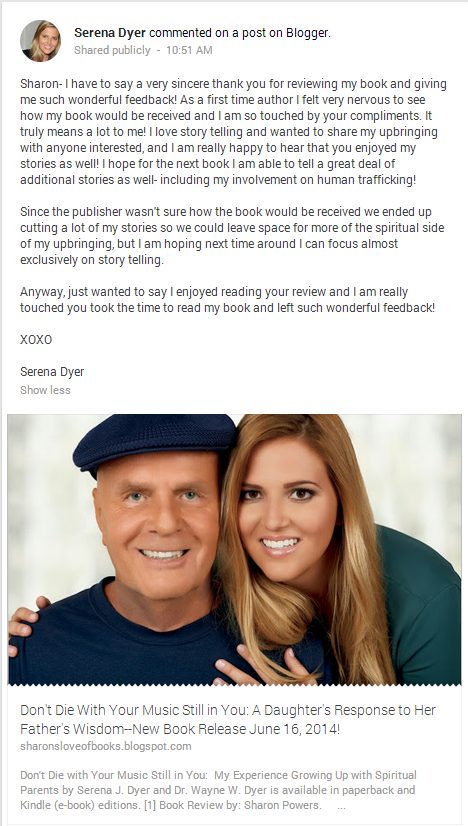
Don't Die With Your Music Still in You: A Daughter's Response to Her Father's Wisdom--New Book Release Today, June 16, 2014!

Don't Die with Your Music Still in You: 
My Experience Growing Up with Spiritual
Parents by Serena J. Dyer and Dr. Wayne
W. Dyer is available in paperback
and Kindle (e-book) editions. [1]
Book Review by:
Sharon Powers.

     Hello, my name is Inigo Montoya. You killed my father. Prepare to die. [Inigo advances on Rugen...] Hello, my name is Inigo Montoya. You killed my father. Prepare to die. [Inigio advances and parries Rugen's attack...] Hello, my name is Inigo Montoya. You killed my father. Prepare to die. [Count Rugen:] Stop saying that! [Rugen attacks, but Inigio parries Rugen and wounds him...] HELLO! MY NAME IS INIGO MONTOYA! YOU KILLED MY FATHER! PREPARE TO DIE! [Inigo corners Rugen and disarms him...Inigo says:] Offer me money. [Rugen:] Yes! [Inigio:] Power, too, promise me that. [Rugen:] All that I have and more. Please... [Inigio:] Offer me anything I ask for. [Rugen:] Anything you want...[2]

     In this scene from the movie, The Princess Bride, Inigio Montoya next says, "I want my father back, you son of a bitch!" and then he kills Rugen. But, in a real life imitation of that movie scene, without the blood, and definitely, funnier, my husband, son, and I, traveling on a photo trip to Yosemite, CA, stopped at a roadside Starbucks for drinks. My son was only asking for a frappaccino--not money, and not power (like Inigio did, just above) and he definitely didn't tell anyone they would die if they didn't get his drink correct! 

My darling son, John, whose wacky sense of humor
prompted him to buy a "meme" tee shirt with the
name of Inigo Montoya on it as a spoof on the
The Princess Bride. [2]

     The young woman who took the order never asked my son what his name was, but only wrote down on the cup, "Inigo Montoya," after quickly glancing at the "name tag" on his shirt. (The name tag is one of those silk-screened, printed, onto a "Think Geek" t-shirt (link). It says, "Hello. My name is: Inigio Montoya, you killed my father, prepare to die."). When my son got his drink, he brought it back to show me and I laughed so hard everyone in Starbucks gawked at me--I, of course, took the picture and posted it to Facebook.

     What is a meme, and how does it relate to this blog post? Serena J. Dyer, in one part of her book, Don't Die with Your Music Still in You, talks about how sometimes we might do things without thinking about why we are doing it. In one definition of the word, "meme," memes are really  just a way of imitating and passing on ideas...or funny thoughts, just like the story of my son and his Inigo Montoya shirt. The internet is rife with "memes," and one website to which both my son and I subscribe is, "9gag.com"--it is nothing but humorous memes.

One societal meme is that
exercise is "hard." [3]
     Serena explains that the difficulty comes when we accept certain culturally conditioned behaviors, like, "Healthy eating is difficult," or "life is hard," that might lead us to a type of behavior we actually don't want...like not even trying to choose healthier food. In a chapter about changing your thinking, Serena tells a charming story about herself, a friend, and how her eyes were opened up to just how she had been culturally conditioned to accept certain attitudes about getting fit. Serena tells how her father, Wayne Dyer, taught her that recognizing memes, understanding them, and changing the use of cultural memes is part of changing the way she thought...she, in turn, teaches us that we can change the way we look at things, too. And...to that end, let's take a look at the book.

THE BOOK:
This is the hardcover edition of
Dr. Wayne Dyer's, 10 Secrets for
Success and Inner Peace
.
 [4]
     Serena informs us that her book basically follows her father's book, 10 Secrets for Success and Inner Peace, and that it is her response to, or her perspective on, learning those "10 Secrets," at her parents knees. Serena gives us, as readers of her book, the unique and intimate perspective on those "10 Secrets."

     Serena places the "10 Secrets," in chapters full of stories and anecdotes, at once personal and deeply intimate. At the end of each chapter, Wayne Dyer, her Dad, responds to what Serena has told us, providing his own perspective on raising Serena (and his other children).

     Serena titled the book, Don't Die with Your Music Still in You: A Daughter's Response to Her Father's Wisdom; it is also the title of the first chapter in her book. She relates that "not dying with your music still in you," is all about how you lead your life, not about what you "do" with your life. She explains that while she was once "irked," about the concept of life being a "journey," now she feels good that she is able to live her life and be on her journey without ever having to change who or what she is for anyone else. In this book, Serena takes us with her on her journey as she grows up in the Dyer household, providing us with insights and amusing stories about her life with a famous father she calls, "Dad."

[5]
Why should we care about this book? Especially to people who have already read, 10 Secrets for Success and Inner Peace, why would anyone want to read a book, ostensibly, based upon a book they have already read? Even Serena clearly states that she has basically followed her father's book in organizing her own story about life with her famous father.

Children have unique perspectives
on living in a family. They see things
differently than adults! [6]
     We should care, first, because even if the basic information from the book, 10 Secrets for Success and Inner Peace, is present, it is most definitely, NOT the same book. What we get, here, is a very personal perspective on the way a young woman was raised by parents deeply involved in writing and public speaking--one involving and practicing motivation and self-help.

     Serena tells us that she likes to tell stories, and that comes through, here. She tells us stories, ones in which she shares with us deeply embarrassing moments of self-revelation and times of her deepest joys, she shares with us stories of friendships made, stories about daily life in the Dyer household, and stories about moments of weakness and triumph. Serena fashions each of her stories so as to illustrate how she learned, first hand, each of her father's 10 Secrets...and, what she is still working on.

     Second, neither is Dr. Wayne Dyer's contribution to the book a rehash of his 10 Secrets book. In each chapter, after Serena has presented her take on the chapter's topic, he responds to Serena's exposition. Wayne responds as a parent would, rather than the world famous public speaker and author. We get to see a deep love for family in the intimate moments that make up the book. We get to see Wayne Dyer as Serena sees him, as Dad.

[7]
     Third, the material presented clearly shows this family living an authentic life. For example, we already know about Wayne Dyer from his books and his extensive public speaking that he wanted to live a life of self-reliance. So, we know that it is important to him that he teaches his children this important concept. Another indicator of living an authentic life is seen in how Dr. Dyer expresses is his profound respect for his children in encouraging them each to live in a way that they will not come to the end of their life with their music still in them. Moreover, in the pages of the book, we get to observe Wayne Dyer teach his children about the danger of following someone else's mental picture (also, societal memes) of who they should be and what they should do with their lives.

     So why should we care about this book? Why should we read it? I think it is important that we can see Serena and Wayne (and the family) living an authentic life, not one in which it is do as I say, not as I do. We get to see the personal side of the family members, not just the public faces. This is important because we see that as hard as they try to put into practice the 10 Secrets for Success and Inner Peace, they still must struggle from time to time with problems--they are human--like us...

Living an authentic life is what Serene Dyer and
Dr. Wayne Dyer try to align with every day. [8]
     ...and yet, their courage to reveal themselves to the world--to let others see not only what they do well, but weaknesses and failures--is a hallmark of living an authentic life. We also know that it is important because we come to understand that in their struggle, there is something with which we can identify. They "get" us. They "understand" us. And here is where it gets really important: one of the critical things we learn from reading this book is that in spite of the struggle, it is possible to take the tools given to us and make our own lives better. We can take our failures, weaknesses, and losses and parley them into something that will give us a rewarding life. A way to journey towards a life where we will not die with our music still in us.

WHAT DIDN'T WORK, FOR ME:
     I liked the overall structure of the book; in fact it reminded me very much of the way Deepak Chopra and his brother Sanjiv Chopra co-authored their book,  Brotherhood: Dharma, Destiny, and The American Dream. In spite of liking the structure, I thought the opening pages of the Dyer book were a bit draggy. I think the opening pages (the Introduction) should have taken advantage of Serena's wonderful story-telling abilities.

This darling little graphic shows us the artist's
concept of the music we all have within us. [9]
     For example, she could have started out with someone, Oprah, for example, asking Serena about what it was like growing up with Wayne Dyer for her father. She could have related a short story about gossiping with her girlfriends (about someone) and how embarrassed she was when caught, and wanting to crawl under the carpet and hide; then, she could have related that it was one of the important lessons she learned in life and how proud she is to have the father she has. This little story would come at the beginning of the Introduction and add to its interest, immensely. Really, any appropriate mini-story would have worked.

    One more minor criticism. I would have loved to hear how Serena got into working with the groups against human trafficking of children. Perhaps she could have tied it into, putting to use, one of the tools she learned from her mom and dad--for example, asking, "How may I serve?" Even a few short paragraphs or a couple of pages would have been nice. I'd like to ask her if she had something like that on her "Vision Board."

MY RECOMMENDATIONS AND RATING FOR THIS BOOK:  
     Recommendations: Most of the book I would consider as a G rated book, suitable for any age person capable of reading. However, in a couple of places the authors deal with serious issues of rape and violent physical assault that might not be appropriate for very young or very sensitive readers.

     For these readers only, I would suggest broaching these topics with an appropriate health professional. To all other readers, especially young adults, I would deem this book as not only appropriate, but essential to personal growth.

Rating: 4.25 Stars out of 5 Stars. [11]
    Rating: My rating of this book was very easy. The rating I give is 4.25 stars out of 5. It is a wonderful, informative, well-written (with the noted exceptions), and entertaining book--deserving of a good rating. I found it to be inspiring and uplifting in the very best sense of those words. I congratulate Serena Dyer on the great job she has done with her first foray into book writing. 

"A Little Piece of God."
For Serena J. Dyer. [10]

     Serena, you are to be congratulated on the manner in which you addressed sensitive issues in your book. Additionally, striking a balance in writing about family is very important--to tell the truth, but to do it in a manner that hurts no one. I am proud of you as a woman who can show such love to your siblings and parents. What a good example you set for all of us. I can see why your father is justifiably proud of you!

     I, personally, would love to see another book from you, perhaps on the work you do with human trafficking of children. You do a great job with your stories, and even if you don't write another book, keep using that skill somewhere in your life. Your determination to continue your journey and to not die with your music still in you is inspirational--your work gives me hope that I, too, can continue my journey and express my "music" before my life is done. Thank you for touching my heart and lifting my spirit.

     Thank you all for joining me this week for the review of the memoir/self-help book by Serena J. Dyer and Dr. Wayne W. Dyer, Don't Die With Your Music Still in You: A Daughter's Response to Her Father's Wisdom. This book will be released June 16, 2014--be sure to pre-order your copy now from your local book purveyor.

     Join me again, next week when I will be picking up another book for review. Remember that reading is good for you mind, and helps to keep your thinking agile and helps you to keep your mind open to new ideas and ways of seeing things.
_________________________________________________________

UPDATE TO BLOG POST:


    At 11:00 a.m. this morning, Tuesday, May 20, 2014, I was notified by Google Plus that one of the authors of this wonderful new book, Don't Die With Your Music Still in You: A Daughter's Response to Her Father's Wisdom, Serena Dyer, shared this blog post. Thank you, Serena. You are so gracious. You really touched my heart with your kind words and appreciation. I loved your book, as I indicated in the blog post. My best wishes to you for success on your (and your father's) book.


_________________________________________________________

Until next time...
"The choices we make dictate the life we lead. To thine
own self be true." --William Shakespeare. [12]
...many happy pages of reading!

My love to you all!

Sharon Powers.


REFERENCES
_________________________________________________________
[1] "Don't Die With Your Music Still in You: A Daughter's Response to Her Father's Wisdom."  amazon.com. Retrieved 04-30-14.
[2] "The Princess Bride." [Scene: Dining Room] princessbride.8m.com. Retrieved 05-06-14.
[3] "Exercise is Hard...Carry Me." cheezburger.com. Retrieved 05-07-14.
[4] "10 Secrets for Success and Inner Peace." amazon.com. Retrieved 05-07-14.
[5] "Why Should We Care?" spectatornews.com. Retrieved 05-07-14.
[6] "Are You a Big Picture Thinker or Detail-Oriented?" quickbase.intuit.com. Retrieved 05-07-14.
[7] "True Sayings Hold On God Knows What He is Doing." tariqmcom.com. Retrieved 05-07-14.
[8] "Journey of the Wild Heart...." mindwisehypnosis.com. Retrieved 05-07-14.
[9] "There is Music In You." greenasday.deviantart.com. Retrieved 05-07-14.
[10] "The Magical Serena Dyer: The Manifestation Q&A Series." themanifestation.net. Retrieved 05-07-14.
[11] "Our Review: The Fault in Our Stars." deliciousreads.com. Retrieved 05-07-14.
[12] "28 White Roses Pictures For Free Download." funstock. Retrieved 04-29-14.

Widget is loading comments...

Friday, May 2, 2014

God's Pocket by Pete Dexter Comes to U.S. Theaters 05-09-14 [Limited Release]--One of Philip Seymour Hoffman's Last Movies.


God's Pocket by Pete Dexter. [1]
Book Review by:
Sharon Powers.

     "Leon Hubbard had worried most everybody on the crew at one time or another, he'd even touched something in Peets. It wasn't the razor--Peets had taken razors away from people, that was as simple as understanding you were going to get cut--it was something in the kid you didn't want to listen to. The truth was, he didn't believe the kid's stepfather was connected. That was more bullshit, the same way the razor was. He kept it in his back pocket and brought it out twenty, thirty times a day. He used it to cut lunch meat and tell stories and shape his fingernails. Once they'd found a bat inside a cinder block and he'd used the razor to cut its head off. Then he'd wrung everything out of the body and said, 'I seen that happen to a nun once.'" (p.4)

This is a straight razor (a gunmetal
titanium  straight  razor), probably
similar to one Leon carries.  My
father used one of these with which
to shave.  My grandfather was a
barber (for a while, in his long life)
who also used this kind of razor
(and not a safety razor); these
razors are extremely sharp and
can be very dangerous! [2]

     The, above, brilliant, disgusting paragraph nails Leon Hubbard's personality down to a "tee." And whether Leon is a psychopath or a sociopath is irrelevant, Pete Dexter shows us in just one short paragraph everything we don't want to know about Leon. For, even if we believe that Leon's little assertion about the nun is "bullshit," we still see something twisted about him, "...something in the kid [we don't] want to listen to." Something in the "kid" we know is about to boil over into trouble. Later, this "not wanting to listen to," this something you don't want to see or know about Leon continues as Peets observes, "It was like when you're watchin' something you don't want to see, but you can't look away" (p. 105). This behavior is often seen in witnesses to a crime--they can't look away and can't help seeing it, but having seen it, still adamantly deny having seen it.

The people of God's Pocket (South Philly) live with this attitude about Leon Hubbard. As you read the book, look to see what else its characters deny hearing or seeing. Relationships. Bigotry. Pain. The "dirtiness" of the city's people--whether or not we refer to the city and its people literally or metaphorically!  [3]
THE BOOK: [Note: Some spoilers are present in the following material.]
     Leon Hubbard is the pivotal point in this story. A story about a young man who, as the book's publisher's say, "had it coming" to him. And what exactly did Leon Hubbard have due and coming to him? Why, nothing more than an "accidental" death. But Leon's mother thinks there's more to the story than meets the eye--even though she cannot explain why she thinks that way. She convinces well-known and popular newspaper columnist, Richard Shellburn, to "look into" things for her. Does the alcoholic and womanizing Shellburn take up the cause just to get into Jeanie Hubbard Scarpato's bed, or is more going on (than a just cause)? 

Philip Seymour Hoffman (on right) stars as Mickey Scarpato,
and John Turturo (on left), stars as Arthur 'Bird' Capezio,
Mickey's friend and accomplice in this scene from the movie,
God's Pocket (set in South Philadelphia, U.S.A.). [4]
     And then there is Jeanie Hubbard Scarpato's hus- band, Mickey Scarpato--Mickey tells his friend, Arthur "Bird" Capezio, about his wife's concerns that something was con- cealed from the family regarding Leon's death. Bird goes to Vinney (a made man in the area) for a favor to have him "look into" things for the family. So now, along with the police, a total of three investigations about Leon's death are taking place. It isn't long before a domino effect has exciting interactions happening all over God's Pocket in South Philly.

Leon is considered to be "bad news."
What other kinds of bad news face the
characters in the book? [5]
     This story is about insiders and outsiders, a mother's love, and a meat wagon with more than just beef in it, and how people deal with "bad news." God's Pocket is irreverent and gritty, hilariously dark and broodingly funny. We must know...will the people of God's Pocket bury the truth about "bad news" Leon because they don't want their illusions destroyed? Will Leon take his "bad news" with him to the grave? Or will Vinney and his boys "kill" the story to keep God's Pocket's "dirty" little secret(s) safe?

MY FAVORITE QUOTE:
     Briefly, to set the scene: Vinney "The Italian," has sent two men to rough up Coleman Peets, foreman on the worksite where Leon died, in an attempt to get information about Leon's death to pass on to Arthur 'Bird' Capezio who then intends to pass the info. on to Mickey, and he to Jeanie. It's the end of the workday and Peets is getting ready to go home--he is standing in the bed of his pickup truck shoveling sand out of it into a pile. The two thugs approach and one climbs up and stands behind Peets. Here's what happens next:
This is a simple brass knuckles--
some are angular and can cut
severely as well as hitting hard. [6]
[The thug said,] 'We can do this the easy way or the hard way....the other one fit his fingers into a set of artificial knuckles...'What's it gonna be home boy?' [Peets said,] 'It happened the way I said to the police, and you Jew boys can do it any damn way you want--hard or easy--and it don't matter to me'....The one who had pushed him threw the hand with the artificial knuckles at Peets' face, and caught the top of his forehead....Peets felt an old calm settle in, he noticed the blood dropping around his boots...he noticed a man across the street [standing and] watching...The one with the knuckles...turned to throw another punch. Peets reached out and smothered his hand, and then found his face, and then, with the same broad motion you might use to shape an eye cavity in clay, he pushed into the corner of the socket and took the man's left eye out...[Peets] caught another look at the man across the street. He was sitting on a fire hydrant now, watching...[The second man, Peets] picked him up by the jaw and the pants and held him over his head...He threw the body now, from the bed of the truck to the ground. One of the legs attached to it hit the rear gate of the truck, twisted and came to rest bridged to the little pile of sand Peets had shoveled out of the truck. The leg looked broken, but Peets jumped down and made sure. Then he looked across the street at the man on the fire hydrant. The man looked back. He stood up, slowly, nodded, clapped five or six times and then headed east down the street. Philadelphia. (condensed quotation: pp. 118-122)
The unknown witness, obviously, follows this attitude
about witnessing Peets attack by the two men and his
defense of himself. [7]
     I really like it that Coleman Peets isn't just going to stand around and wait for two thugs to beat him senseless, or put him in the hospital. And while we don't know, in the story, who the watching bystander is, who approves and even applauds Peets' handling of the situation, in some sense, we as readers, join that anonymous bystander in cheering Peets.

     Even so, after the applause and cheering has died down, we must consider that the bystander, like many witnesses to crimes or violent behaviour, does not call the police. He is one of those silent witnesses who sees nothing, hears nothing and knows nothing. Street justice has been served. But, if we know anything about "made men," we know the boss cannot just let it go that his men were beaten and hospitalized--someone will have to pay. But in this case, it isn't Peets. The vingnette reinforces Pete Dexter's motifs in the story of the unseeing and unhearing witnesses who live in God's Pocket.

WHAT (ELSE) I THINK ABOUT THE BOOK:
     A number of wonderfully interwoven themes exist, so let's just look at a few of the most important themes. Then we will take a look at the trailer for the upcoming movie about God's Pocket.

An image of a butcher cutting up a
side of beef, similar to Tony in the
book, God's Pocket. [8]
(1)     The themes of "safety" and "knives": We start out with Leon's straight razor, a knife. It is the opposite of a "safety" razor--it is anything but safe; so, what we are really talking about is, "not being safe." Of other knives in the story, one of particular interest is the one used by the butcher boy, Tony ('Bird's' nephew) who uses it to cut up the stolen meat (a big part of the black humor of the book and movie). The young man is so proficient at cutting up the meat, that watching him put them in mind of Leon, and one could almost see Leon with his razor (p.111).

     And then there is Richard Shellburn, the columnist, and an outsider to the Pocket, who carried a picture in his head that he was SAFE all the time. He even had a little retreat, a secret little plot of land he could retreat to when things got to him (p. 136). But Shellburn wasn't safe; and, he never saw it coming. The danger came from his boss.

Richard Shellburn created a picture in
his head that he was "SAFE" all the
time. Little did he know that he was
about to be taken out in his own
end zone. [9]
     In fact, his boss, T.D. Davis, had lived through something traumatic that had him always looking at the "timing" of things. At a former paper, an employee came in wielding a chain saw and cut up his desk--in an attempt to keep things quiet Davis had issued a "no talk" order. It leaked out to the other papers and Davis was fired. Ever after, Davis always kept a watchful eye on employees. In a meeting one day with Shellburn, Davis considers that he has not been as vigilent with Shellburn as he should have been.

     Davis doesn't want Shellburn to destroy him, so he sets Shellburn up--takes him out first. Davis knows that the piece Shellburn wants published will spell his ruin and perhaps his death, so, Davis approves the article for publication. Later, the people of God's Pocket are so incensed by Shellburn calling them "dirty," that one evening at a bar (while Shellburn is having a heart attack) they attempt to beat him to death. But he dies first, and they end up beating his dead body.

Not a great photo, but here we are at
a high school football game. This is a
"safety" where you tackle an oppo-
nent in his own end zone. [10]
     What happened here, to Shellburn, is called a "safety" in football. Where you are tackled from behind your own goal line, often, not seeing it coming. That is, basically, what happens to Shellburn--he gets taken out behind his own goal line. Alternatively, you can look at Shellburn and his assistant, Billy Deebol, as playing the safetymen who defend the furthest area back in the field--God's Pocket. But I like the "Safety" definition, better. I wonder if T.D. Davis's initials stand for "Touch Down"? It's not the same thing as a "safety," but it's still kinda funny...eh?

     Finally, we have safety as used in the workplace, and safety in sex (rubbers)--I'm thinking of Leon's sexual liason with Fat Pat, here; also safety when the judge (Kalquist) acts in a trial to protect an accused man on charges of murder. Jeanie Hubbard, after her first husband's death, accepts Mickey Scarpatto and marries him because she feels safe with him. And then there is the whole neighborhood--anyone who is "OF" God's Pocket is safe in the group--it's the outsiders who have to watch out.

Mickey thought he was one of them
for a while, but soon had to face facts
that hadn't ever been one of them, and
he wasn't, even, now. Shellburn never
does understand that he's an outsider,
this, eventually, costs him his life. [11]
(2)     Outsiders/Insiders:     If you were born and raised in God's Pocket, you're in, if not, no matter how long you are there, you're still an outsider. The night of Shellburn's death, when the patrons are attacking Shellburn, the bartender tells them to "take it outside." And, Mickey, in God's Pocket for years, and married to an insider (Jeanie), making deliveries to the bar for years, is told, "You ain't from here either, so stay the fuck out of it" (p.267). Later some street kids tell Mickey, "Yo, Mick...we want you to know we 'preciate you not talkin' to the cops. You stood up, like you was part of the Pocket." Mickey responds, "Don't include me in nothin' about the Pocket." (p. 269).

Philip Seymour Hoffman. Unlike the
characters in the book and film, seeing
you "in the light once," is just not
enough. We watched you leave...
we know of your problems with drugs
and we want to keep you, anyway.
We want to forgive you for leaving,
but we can't--we can't let go of you
because you are one of us, and we love
you. We always will. Thank you for
giving us a little bit of yourself in the
beautiful films you made.  Thank you.
We love you. God speed. [12]
(3) Forgiveness, Leaving the Neighborhood, and Love: The scene takes place in the Hollywood Bar where Ray and Mickey are talking. Everything we need to know about the Pocket happens in this conversation:
Rays says, 'The average American has substituted cliches for thought.' Ray threw down another shot and asked Mickey, 'You want to know the real reason I never left?...The real reason,' he said, 'is forgiveness'...'I want to be forgiven.' Ray shook his head, 'You can't forgive me [Mickey],' he said. You're an intelligent man, but you don't know anything, here. I grew up with these people. They've seen me lying in puke and I've seen them lying in puke'...no matter what I am they've got to forgive me...The only thing they can't forgive is leaving the neighborhood...McKenna gave last call at two and turned on the lights...somebody yelled, 'Yo, turn off the fuckin' lights.' McKenna went back to the wall and dimmed the lights. 'Drink up,' he said again. And they did. They'd seen each other in the light once, and that was enough...Mickey watched them leave...and he knew in that moment exactly what Ray had been talking about, only he'd said forgiveness when he meant love. Mickey could see how you could get them mixed up. (p.227)

    By the end of the book when Mickey leaves we can see he better understands about forgiveness and love with his wife--perhaps there was not love there, only acceptance and safety, for a while; he keeps his crazy friendship with 'Bird,' and perhaps that is enough...(fraternal) love. And then, of course, they commit the one unforgiveable sin, they "leave the neighborhood."

THE MOVIE: Take a look at this insane trailer [13], rife with black humor and making me laugh out loud. I loved seeing Hoffman (AKA Mickey) chasing down the meat truck on foot, which, in turn, causes a traffic accident with a bus, and that, in turn, causes Leon to fall out of the refrigerated truck and into the street...to the amazement of all! [Note: only part of this scene is in the trailer.] Of course, I've read the book and can "read" some of the scenes and know why they are included. If you read the book, you'll get in on the "inside" jokes, too.


     Philip Seymour Hoffman stars as Mickey Scarpato, and John Turturro as Arthur 'Bird' Capezio, and Joyce Van Patten as 'Bird's Aunt Sophie (You just gotta love Aunt Sophie--what a surprise she is, and...what a pistol!), Christine Hendricks as Jeanie Scarpato, Caleb Landry Jones as Leon Hubbard, Bill Buell as Ray, Richard Jenkins as Richard Shellburn, Arthur French as Lucien 'Old Lucy' Edwards and Glenn Fleshler as Coleman Peets. Writing Credits go to Peter Dexter for the novel and Alex Metcalf and John Slattery for the screenplay; Directing the movie is John Slattery. The movie is Rated R, is 88 minutes long, and is placed in the Drama category. The movie opens in theaters in LIMITED RELEASE on May 9, 2014 (USA).


MY RECOMMENDA- TIONS AND RATINGS:

     The Motion Picture Rating (MPAA) is R. In this movie it is rated R for the violence, the language throughout the movie and sexual content in- cluded. I would, likewise, rate the book the same way.

     I do not recommend this book for young children, or for some sensitive readers who are easily distraught over death and violence or bad language. I do, however, recommend this book to all adults who may enjoy black humor, gritty realism, and an irreverent look at life.

     This story is set in South Philly (God's Pocket, South Philadel- phia), and is, therefore, a regionally-based story. Those who know nothing of Philly may not understand all the re- gional references taking place within the context of the book and movie.

    I was surprised by this book. I, normally, don't care too much for black humor, but this book was not so "off the wall" that I couldn't enjoy it. As a matter of fact, the tongue-in-cheek satire where the book pokes fun at its own characters and city and life-style really made me chuckle. No. Not the loud guffaw, but the chuckle. The, "Yeah, I got it" chuck, chuck, chuckle.

     Way to go Pete Dexter! I'm on my way to read, Paris Trout, soon. In fact, I've already ordered the book and it will be sent to me in short order. For all the above reasons, I rate this wonderful book with the story set in the 1980s at 4.5 stars out of 5 and give it a thumbs up. I recommend that before all the used copies are snatched up that you grab one and buy it and read it for yourself.

5 Star Rating System [17]
   Thank you for joining me this week as we looked at this cult favorite, God's Pocket, by Pete Dexter. I'm glad it is coming to the movies, but from what I have seen of the professional critics reviews of the movie, it isn't rated well. In fact, the metascore is only 28/100. It may be another reason for releasing it in Limited Release, first, so as to test the waters, so to speak. I hope it does well. I don't always agree with professional critics assessment of movies--perhaps you have also had this experience? In any event, we have to wait and see what happens. It would be lovely if one of Mr. Hoffman's last movies did well at the box office. ...Such a wonderful actor.

     Thank you for taking time to read my blog post, today! Please join me again next week as we take another book into consideration for reading enjoyment and find out whether or not it is sufficiently worthy to spend your money on, pick it up, and spend your valuable time reading it. Until then, you couldn't do better than to find a copy of God's Pocket, and read it. It is relatively short, only 279 pages, and enjoyable. So, give it a try.

Until next time...
White Rose. [18]
...many happy pages of reading!

All my love,

Sharon.


REFERENCES
_________________________________________________________
[1] "God's Pocket." amazon.com. Retrieved 04-28-14.
[2] "Gunmetal Titanium Straight Razor." venusworldwide.com. Retrieved 04-29-14.
[3]"Quotation of the Week." openyoureyesnew.com. Retrieved 05-01-14.
[4] "Philip Seymour Hoffman in the First Trailer for 'God's Pocket.'" movienewsplus.com. Retrieved 05-01-14.
[5] "Two Key Communication Tips When the News is Bad." people-results.com. Retrieved 05-01-14.
[6] "The Republican Party Puts on the Brass Knuckles." costonscomplaint.blogspot.com. Retrieved 05-01-14.
[7] "Hear nothing...." dolores-maxwell.com. Retrieved 05-01-14.
[8] "Close up view of butcher cutting meat at warehouse." colourbox.com. Retrieved 05-02-14.
[9] "Sunday Paper Coupons." couponaholic.net. Retrieved 05-02-14.
[10] "Introduction to American Football--Rules of US Football." fabqb.com. Retrieved 05-01-14.
[11] "True Internet Marketing Icons/How Online Marketing Works." seobrook.com. Retrieved 05-02-14.
[12] "Philip Seymour Hoffman Set To Star In John Slattery's GOD'S POCKET." wearemoviegeeks.com. Retrieved 05-02-14.
[13] "God's Pocket Trailer." youtube.com. Retrieved 05-02-04.
[14] "The Book You Have to Read: 'God's Pocket,' by Pete Dexter." therapsheet.blogspot.com. Retrieved 05-02-14.
[15] "Out-of-Print." dictionary.reference.com. Retrieved 05-02-14.
[16] "God's Pocket." [Definition] urbandictionary.com. Retrieved 05-02-14.
[17] "Man of Steel (2013)." [4.5 Stars.] meonthemovie.blogspot.com. Retrieved 05-03-14.
[18] "28 White Roses Pictures For Free Download." funstock.com. Retrieved 04-29-14.